 English
 Español
Mips vs Nuro: What’s the Difference in Helmet Protection?
Not all safety helmets protect the same way.
Most serious jobsite head injuries don’t come from straight, vertical impacts—they come from angled hits that create rotational force. That twisting motion inside the brain is a leading cause of traumatic brain injuries.
Modern helmet systems found in Type 2 safety helmets, including Securis helmets with Mips® technology and Hardknock helmets with Nuro technology, are designed to address this exact problem—but they do it in different ways.
The Problem: Why Rotational Impact Matters
When a worker slips, trips, or falls, the head rarely hits straight-on.
Instead, it strikes at an angle—creating a rotational force that causes the brain to twist inside the skull. Traditional hard hats are not designed to manage this type of impact.
That’s why more companies are moving toward Type 2 safety helmets, which are designed to provide protection from top, front, back, and side impacts.
If you’re evaluating whether your crew should be making the switch, we break it down in more detail here:
Do You Need a Type 2 Safety Helmet?
How Securis (Mips®) and Hardknock (Nuro) Work
Securis Helmets with Mips® Technology
Securis helmets feature a low-friction internal layer that allows slight movement (typically 10–15mm) inside the helmet during an impact.
This movement helps redirect rotational energy away from the head—reducing the forces that can lead to serious injury.
Hardknock Helmets with Nuro Technology
Hardknock helmets use a cellular structure built directly into the helmet.
This structure is designed to:
- Flex
- Compress
- Glide
…helping manage both direct impacts and rotational forces in a more integrated way.
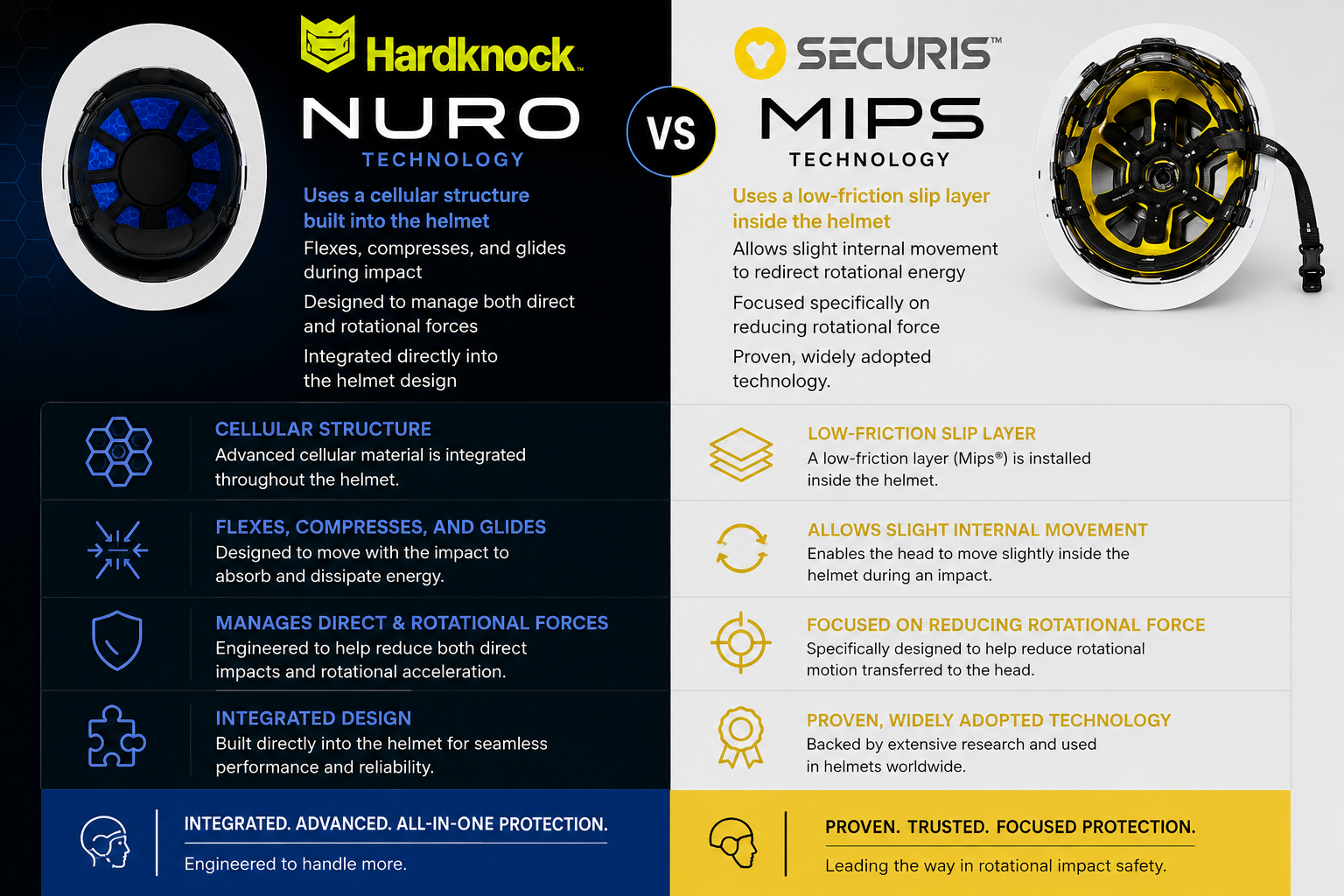
Securis (Mips®) vs Hardknock (Nuro) — Key Differences
Securis Helmets (Mips®)
- Uses a low-friction slip layer inside the helmet
- Allows slight internal movement to redirect rotational energy
- Focused specifically on reducing rotational force
- Proven, widely adopted technology
Hardknock Helmets (Nuro)
- Uses a cellular structure built into the helmet
- Flexes, compresses, and glides during impact
- Designed to manage both direct and rotational forces
- Integrated directly into the helmet design
Which One Is Right for Your Crew?
Both systems are designed to address rotational impact, which is a major step forward compared to traditional hard hats.
The right choice depends on:
- Jobsite conditions
- Crew preferences
- Comfort and fit
- Accessory requirements
The most important step is moving toward Type 2 safety helmets that account for real-world impacts.
What This Means for Your Jobsite
If your crews are still using traditional hard hats, they may not be protected against the most common types of impacts seen on today’s jobsites.
Upgrading to Securis helmets with Mips® or Hardknock helmets with Nuro, both built within modern Type 2 safety helmet designs, is one of the most effective ways to improve head protection.
Choosing the Right Type 2 Safety Helmet
If your priority is rotational impact management with a proven low-friction system, Securis helmets with Mips® are an excellent option.
If you want a fully integrated energy management system designed to handle both direct and rotational impacts, Hardknock helmets with Nuro™ technology offer a different approach.
Explore both helmet systems below.
Shop Securis Type 2 Helmets (Mips®)
Shop Hardknock Type 2 Helmets (Nuro)
Or reach out orders@tprindustrial.com and we’ll help you choose the right setup for your crew.
